
AI Science & Discovery
Brain organoids classify Braille signals at 83%
A three-organoid setup outperformed a single organoid in a lab test of biohybrid signal processing.
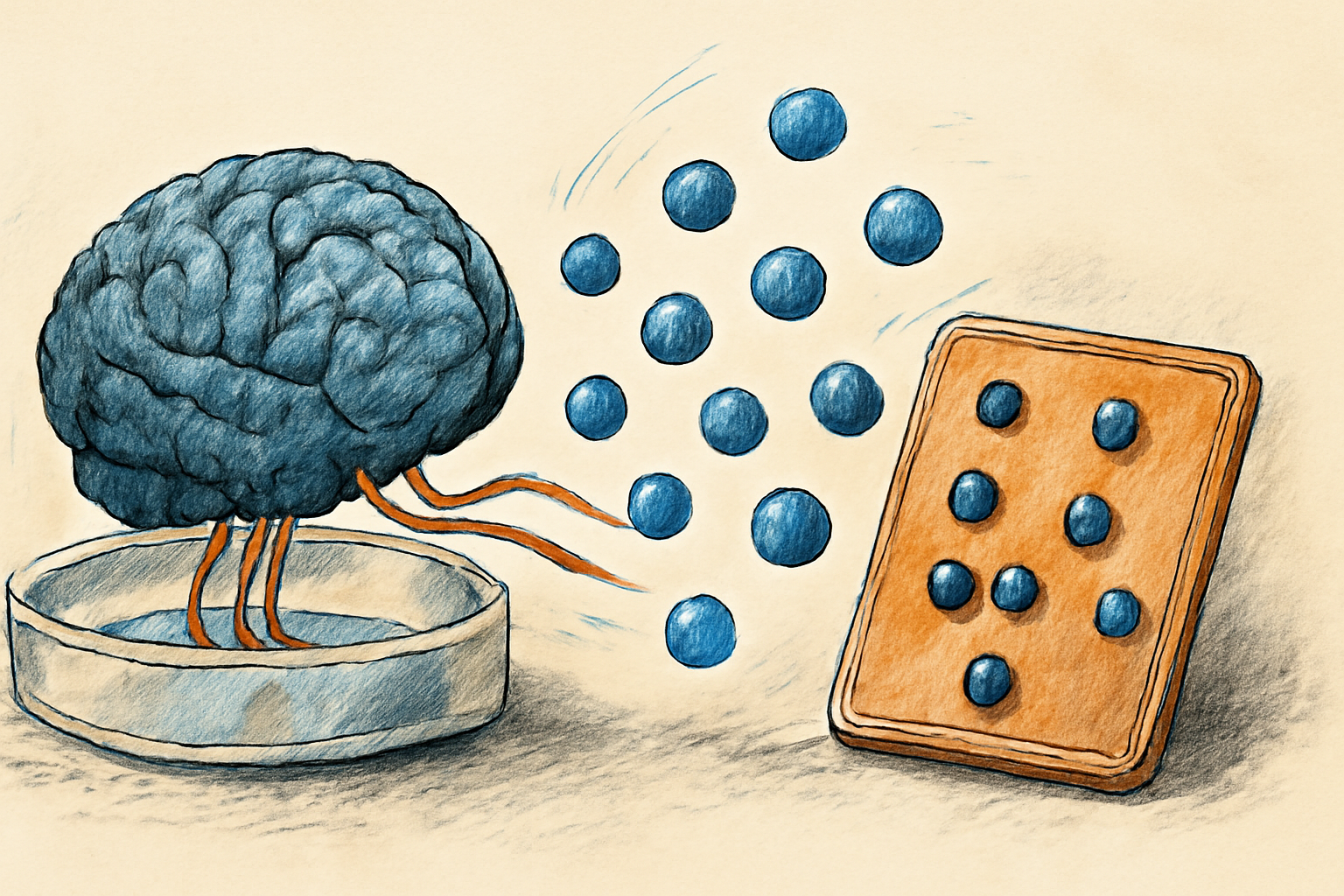
Illustration of a small brain organoid on a microelectrode array connected to a tactile sensor displaying Braille dots.
Photo: Kronos News
Researchers used lab-grown human forebrain organoids to process electrical signals based on Braille letters. A machine-learning decoder classified signals from one organoid with 61% accuracy, rising to 83% when it combined responses from three organoids. [1][2]
The experiment converted tactile sensor readings into electrical stimulation delivered to organoids on a microelectrode array. Researchers then used a support vector machine to classify the organoids’ neural activity; the study also reported improved performance against artificially added noise. [1][2]
The results show signal processing in a limited, open-loop task—not that the organoids learned to read. The researchers said they did not test learning or long-term changes, and the study used a fixed encoding scheme and one tactile task. [1][2]
Editorial notes
Transparency note
AI assisted drafting. Human edited and reviewed.
- AI assisted
- Yes
- Human review
- Yes
- Last updated
Risk assessment
This is an early, limited lab demonstration using one fixed, open-loop tactile task.
Sources
- 1.↗
frontiersin.org
https://www.frontiersin.org/news/2026/10/16/mini-brain-organoids-reading-braille-biohybrid-computing-frontiers-artificial-intelligence
- 2.↗
frontiersin.org
https://www.frontiersin.org/journals/artificial-intelligence/articles/10.3389/frai.2026.1800219/abstract
- 3.↗
404media.co
https://www.404media.co/computers-made-of-human-brain-tissue-identify-braille-letters-in-breakthrough/
Related stories
View all


Topics
About the author
Kronos News Desk covers ai science & discovery and editorial analysis for Kronos News.