
AI Science & Discovery
JWST Maps Uneven Atmosphere of WASP-17b
A new transit-mapping method reveals a more extended evening side on the hot Jupiter.
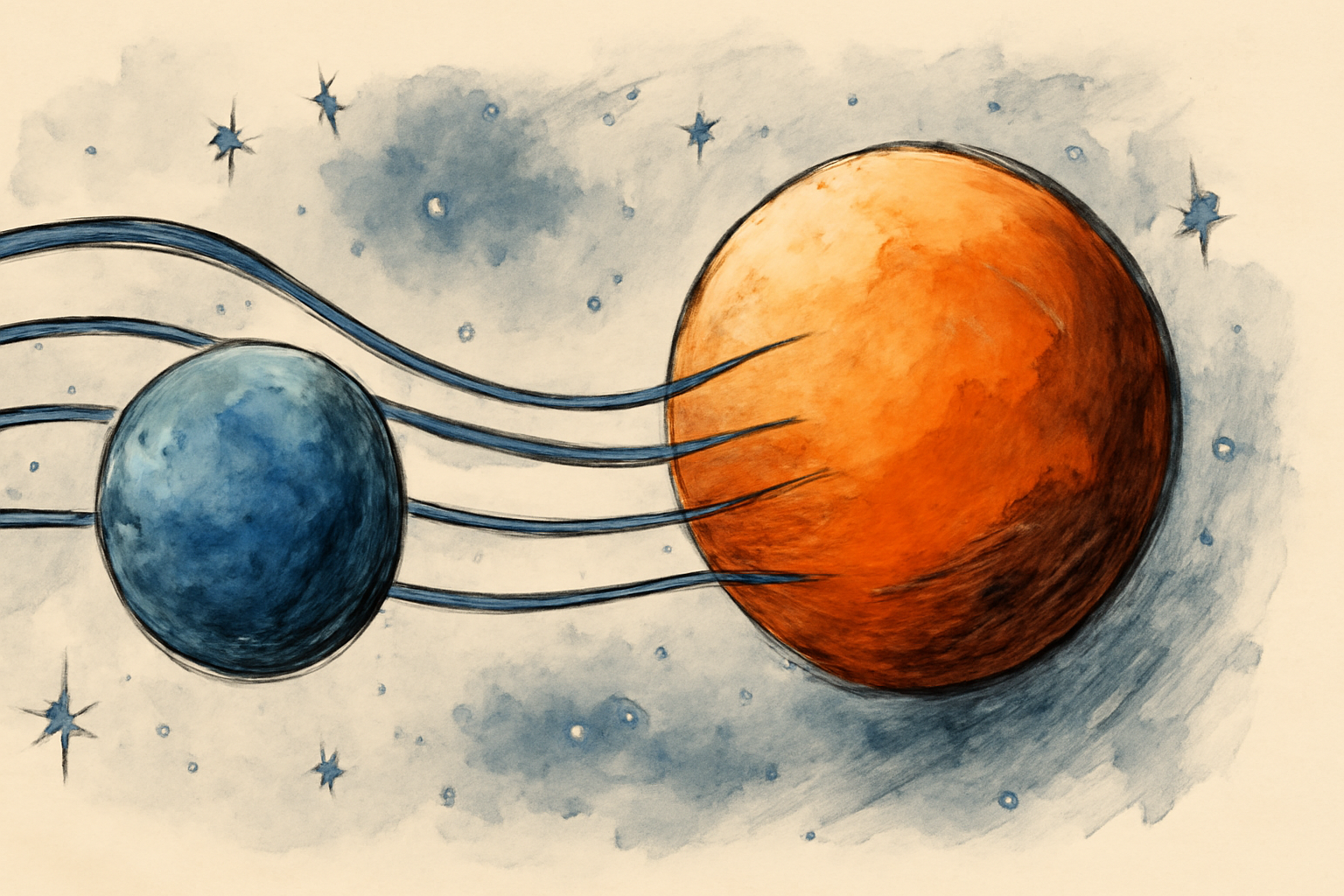
Illustration of WASP-17b crossing in front of a star, with one side of its atmospheric outline extending farther than the other.
Photo: Kronos News
JWST observations have revealed uneven contours in the atmosphere of hot Jupiter WASP-17b, using a technique called “transmission strings” to map different parts of the planet’s edge rather than averaging them together. [2][3]
The method tracks the planet as it passes in front of its star, measuring starlight filtered through its atmosphere from different angles. Researchers found the evening side near the equator is more extended than the cooler morning side, a pattern consistent with winds carrying heat from the planet’s permanently lit side toward its night side. [2][3]
The study also reports temperature and chemical-composition patterns consistent with theoretical predictions and other modeling. This is a demonstration on WASP-17b, not evidence that the method has mapped other planets or established weather patterns across exoplanets; researchers describe broader mapping as a future possibility. [2][3]
Editorial notes
Transparency note
AI assisted drafting. Human edited and reviewed.
- AI assisted
- Yes
- Human review
- Yes
- Last updated
Risk assessment
The Nature Astronomy paper could not be accessed directly.
Sources
- 1.↗
nature.com
https://www.nature.com/articles/s41550-026-02986-4
- 2.↗
news.cornell.edu
https://news.cornell.edu/stories/2026/10/pulling-strings-new-method-maps-exoplanets-true-shape
- 3.↗
bristol.ac.uk
https://www.bristol.ac.uk/news/2026/october/trailblazing-technique-uncovers-real-shape-of-scorching-hot-exoplanet-atmosphere.html
Related stories
View all


Topics
About the author
Kronos News Desk covers ai science & discovery and editorial analysis for Kronos News.