
AI Science & Discovery
MIT’s WorldParticle AI Simulates Materials and Proteins
The researchers report one transformer architecture can model six types of physical systems, with faster protein simulations.
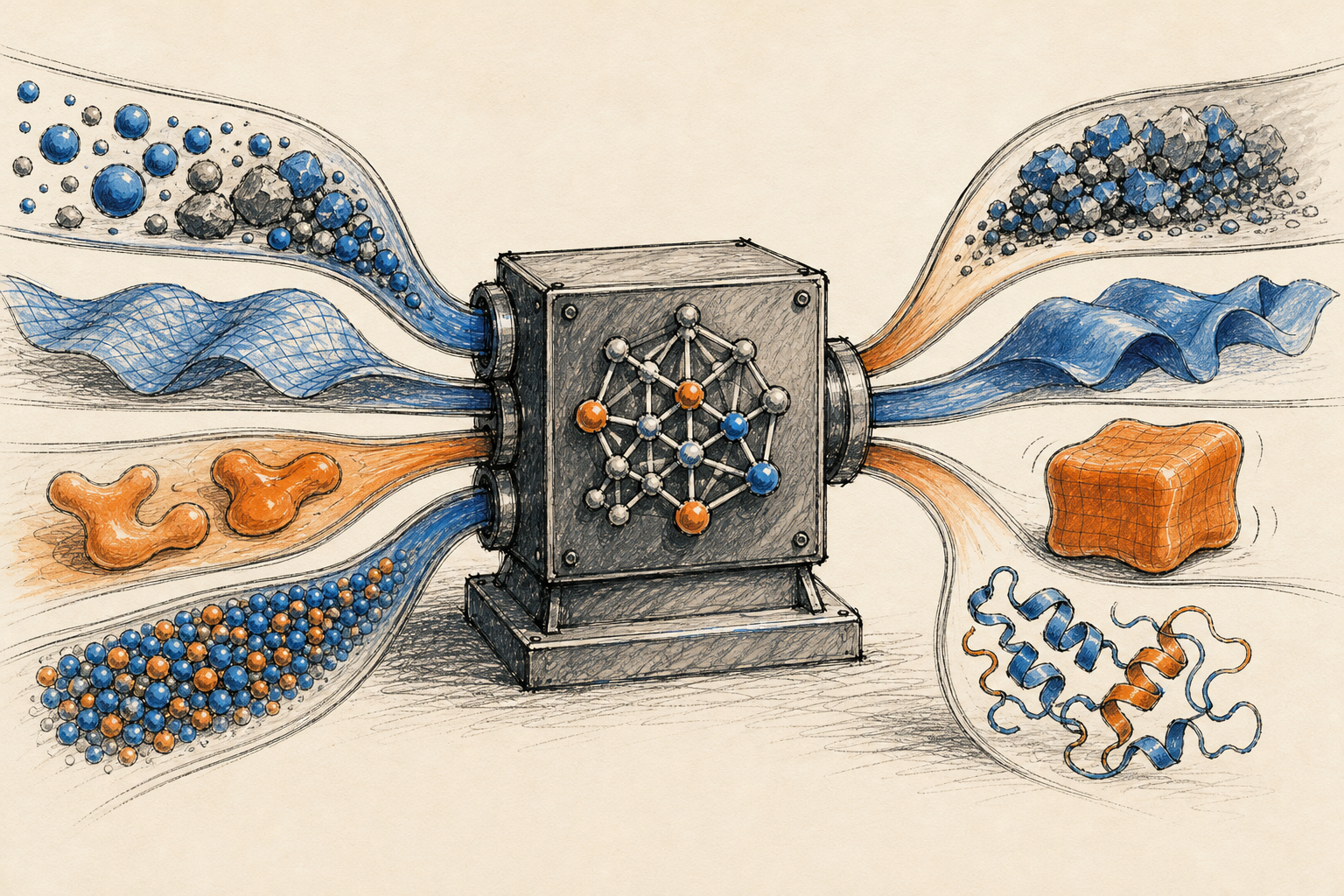
Illustration of particles representing sand, a soft material, fluid, and a protein in a scientific simulation.
Photo: Kronos News
MIT researchers and collaborators have developed WorldParticle, a transformer-based AI simulator that represents physical systems as particles and predicts how they move. The team says one architecture modeled six categories of dynamics, including deformable solids, fluids, granular materials and molecular systems. [1][2]
In the researchers’ reported comparisons, WorldParticle was more accurate than numerical simulation methods, and its protein-dynamics simulations ran about 100 times faster than numerical simulators. [1] The paper was submitted to arXiv on May 14, 2026, and describes a system tested across varied physical scenarios. [2] These are research results, not evidence of clinical effectiveness or broad real-world performance; the speed and accuracy claims are the researchers’ comparisons, not independent validation. [1][2]
Editorial notes
Transparency note
AI assisted drafting. Human edited and reviewed.
- AI assisted
- Yes
- Human review
- Yes
- Last updated
Risk assessment
Performance claims come from the researchers’ reported comparisons and have not been independently validated in the supplied sources.
Sources
Related stories
View all
Topics
About the author
Kronos News Desk covers ai science & discovery and editorial analysis for Kronos News.