
AI Science & Discovery
Voltage switches magnetic states in tetralayer graphene
Researchers used electrical gating to trigger layer sliding and non-volatile magnetic switching in a low-temperature experiment.
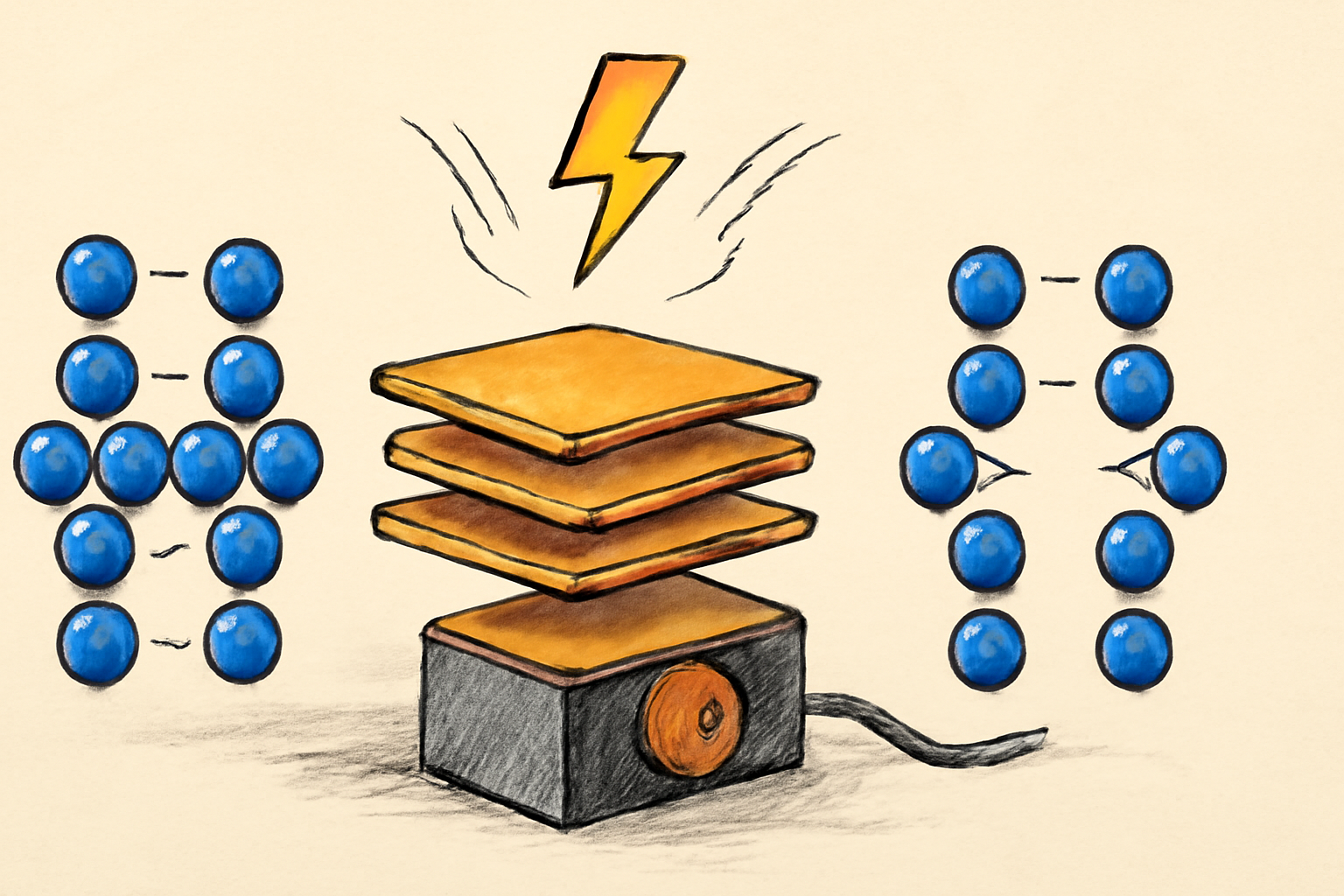
Illustration of four graphene layers slightly shifted relative to one another under an electric gate field.
Photo: Kronos News
Researchers report that gate voltages can switch tetralayer graphene between nonmagnetic and ferromagnetic phases by shifting how its atomic layers are stacked. The change persisted after the voltage was removed, demonstrating non-volatile switching in the experiment. [1][2]
In the Nature Nanotechnology study, transport measurements on marginally twisted double-bilayer graphene showed bistable switching between a Bernal-dominant arrangement and a mixed state containing Bernal and rhombohedral regions. The researchers identified the magnetic phase through low-temperature measurements, including an anomalous Hall effect. [1]
The results demonstrate electrical control of magnetic states in this graphene system, not a working memory device or proof of practical applications. The study also suggests that boundaries between differently stacked regions may contribute to the Hall signal, leaving the precise mechanism open. [1]
Editorial notes
Transparency note
AI assisted drafting. Human edited and reviewed.
- AI assisted
- Yes
- Human review
- Yes
- Last updated
Risk assessment
The finding is supported by a peer-reviewed study, but it is an experimental result in a specific low-temperature graphene system; practical device applications are not established.
Sources
Related stories
View all


Topics
About the author
Kronos News Desk covers ai science & discovery and editorial analysis for Kronos News.