
AI Models & Agents
Study links deep-learning instability to fractal basins
A University of Sydney account says tiny changes to starting conditions can shift training outcomes, even in deterministic settings.
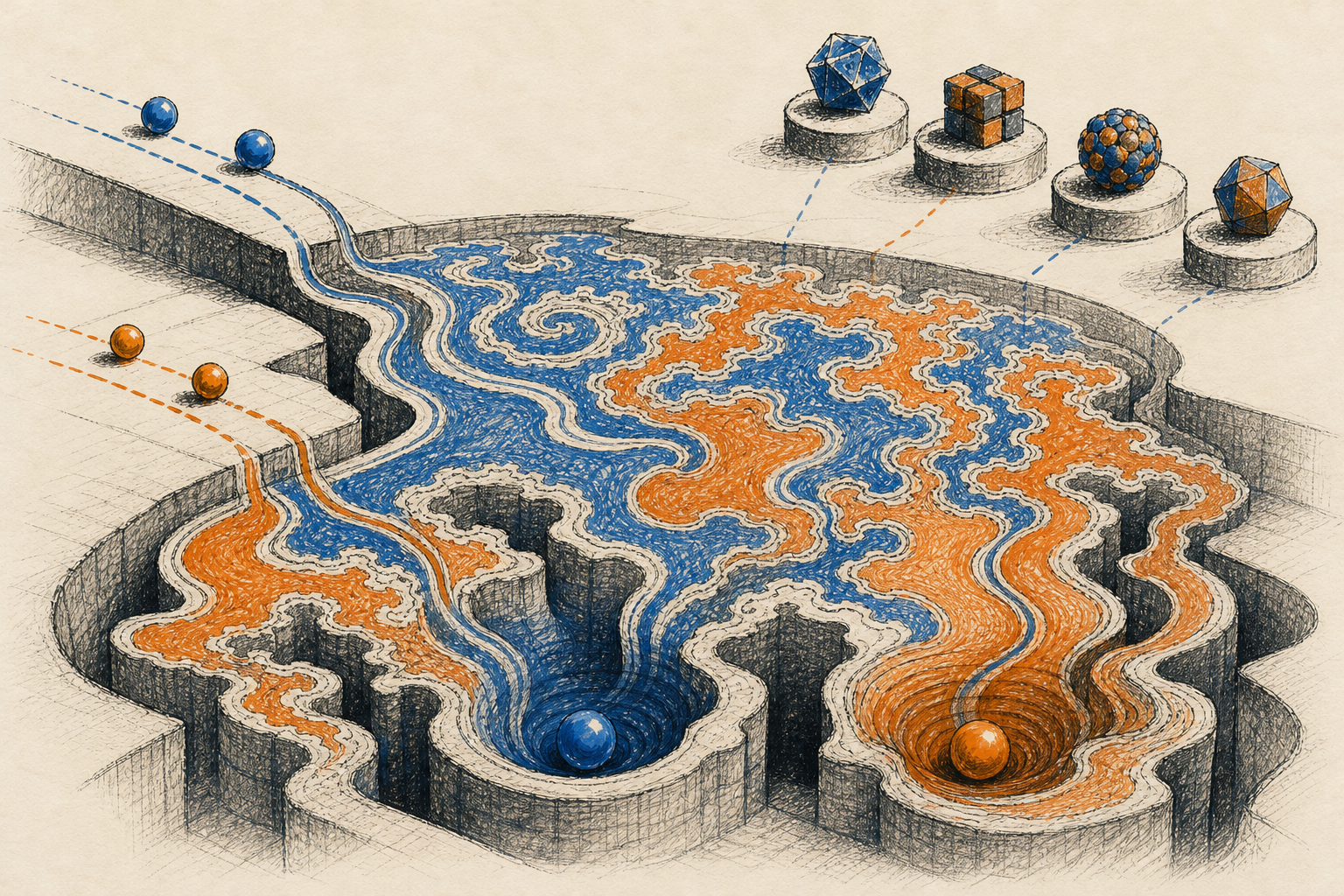
Abstract scientific illustration of two nearby starting points in an interwoven training landscape leading to different outcomes.
Photo: Kronos News
A study by University of Sydney researchers proposes that intricate, fractal-like “riddled basins” in neural-network training may help explain why tiny changes to a model’s starting parameters can lead to different outcomes. The university says the effect persisted in deterministic computing environments, where repeated runs otherwise produce identical results. [2]
The university’s account reports that the researchers analyzed about 500,000 networks across tasks including image recognition and text processing, finding signatures consistent with riddled basins across architectures, datasets and training methods. In one image-recognition network, changing a starting setting by one bit led to a different internal configuration in about 48 percent of cases. [2]
The findings offer a proposed mathematical explanation for limits on reproducibility; they do not show that every neural network behaves this way or establish a practical fix. The university says lowering the learning rate improved reproducibility in the study but reduced learning effectiveness. [2]
Editorial notes
Transparency note
AI assisted drafting. Human edited and reviewed.
- AI assisted
- Yes
- Human review
- Yes
- Last updated
Risk assessment
The Nature Machine Intelligence article could not be accessed for verification; the report relies on the University of Sydney’s summary, and claims are attributed accordingly.
Sources
Related stories
View all
Topics
About the author
Kronos News Desk covers ai models & agents and editorial analysis for Kronos News.